ByteAsk Raises $1 Mn Led by Y Combinator for C++ AI Agents
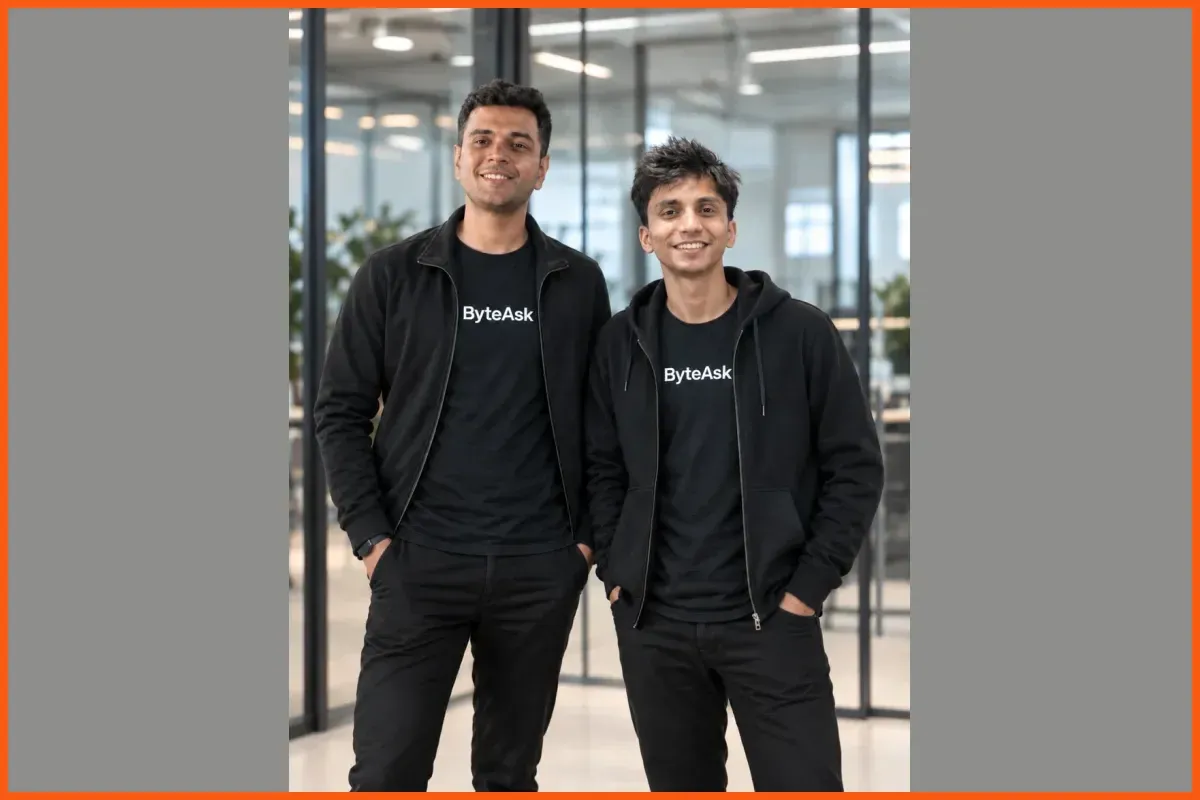
ByteAsk has raised $1 million from Y Combinator and Entrepreneur First to build AI coding agents for C and C++ in defence, trading, automotive and semiconductors. On the two programmes' published standard terms, roughly $375,000 of the round came from angels. ByteAsk, a San Francisco company building AI coding agents for C and C++, has raised $1 million inpre-seedfunding fromY Combinatorand Entrepreneur First, alongside angel investors who work at global quantitative trading firms. Both institutional backers publish standard terms. Y Combinator's is $500,000: $125,000 for a fixed 7% on a post-money SAFE, plus $375,000 on an uncapped SAFE with a most-favoured-nation clause. Entrepreneur First's India programme invests $125,000 for an 8% convertible. On those published terms the two programmes account for $625,000 of the round, which leaves roughly $375,000 coming from individuals. That is an unusually large angel component for a pre-seed, and it tracks with founders who spent their careers inside trading firms, where the people writing those cheques are also the people who would use the product. The company was founded in June 2026 and sits in Y Combinator's Fall 2026 batch, the cohort that runs October to December in San Francisco. Founders Anirudha Kulkarni and Pratyush Saini say it is one of five India-founded companies in that batch. Operations are split between the US and India. MostAI coding agentspropose a change and stop there. ByteAsk runs the change through the toolchain before a developer sees it. It compiles with the project's own flags and build system, runs the test suite, and puts the result through memory and threading sanitizers: AddressSanitizer, UndefinedBehaviorSanitizer, ThreadSanitizer and Valgrind. It attaches to live gdb and lldb sessions, runs clang-tidy and clang-format, and reads compiled output through objdump, nm and readelf. It works from a terminal or inside an editor, and covers the usual C++ build stack: Two details matter for the customers it is chasing. The agent ships a reference layer that cites the standards these engineers are actually held to, including AUTOSAR, MISRA and the STM32 and x86-64 manuals, rather than paraphrasing them. And it can run entirely on-premises, with a choice of ByteAsk-managed models, the customer's own API keys, or self-hosted models through vLLM, Ollama, llama.cpp or LM Studio, which are not metered. Read-only commands execute on their own; anything that changes state waits for approval. Code and prompts are deleted after processing, and there is a free tier. The gap ByteAsk is building against is real but thinly measured. SWE-bench, the benchmark most model releases quote, is built on Python repositories. Multilingual equivalents arrived much later and are far smaller: Multi-SWE-bench carries 1,632 instances across seven languages including C and C++, and SWE-Bench ProMax covers 170 refactoring instances across the same seven. A model can look strong on the headline coding benchmar
Original source: StartupTalky