Government to Match VC Investments in Indian Chip Startups Under Semicon 2.0: ISM CEO
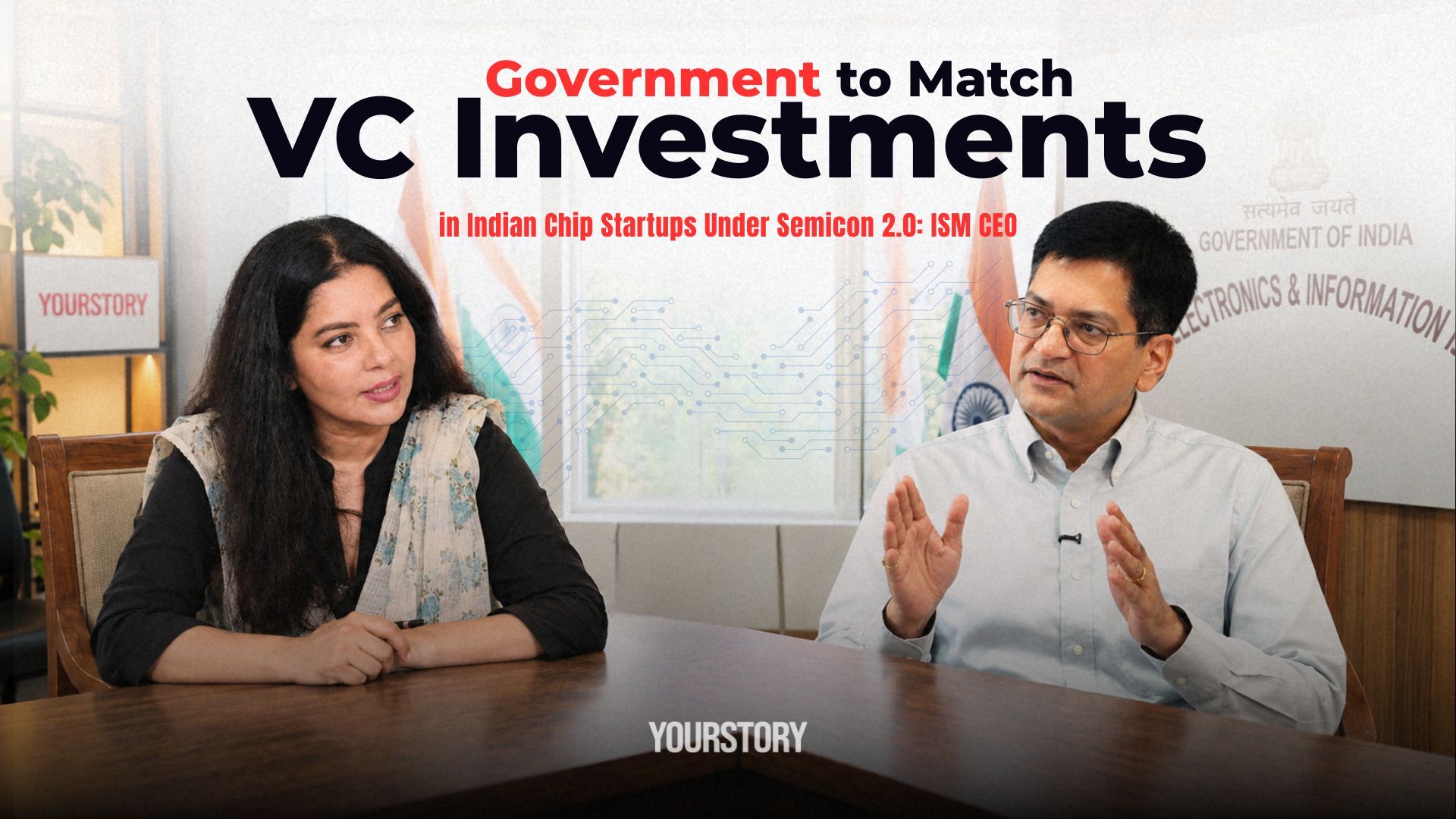
When the government backs a chip startup and it gets acquired, is that a failure? Amitesh Kumar Sinha, Additional Secretary at the Ministry of Electronics and Information Technology and CEO of the India Semiconductor Mission, has a ready answer: not necessarily. It can also be a return on investment. That distinction is becoming more important as India enters the next phase of its semiconductor push. Indian semiconductor companies have attracted $1.4 billion in cumulative equity funding, with $701 million, nearly half the total, raised since 2025, according to Tracxn data. Now the government wants to bring more private capital into chip design by investing alongside venture capital firms. Speaking to Shradha Sharma, Founder and CEO of YourStory and The Bharat Project, days before Semicon India 2026 opens in New Delhi, Sinha laid out the thinking behind Semicon 2.0, the second phase of the mission that turns the government from grant-giver into co-investor, including a model under which the government will match VC investments in approved chip startups rupee for rupee on the same terms. "Seed funds for startups are grants; the rest is our investment, so the government shares both the upside and the failures," he said. When YourStory last spoke to Sinha ahead of Semicon India 2025, the India Semiconductor Mission had 10 approved projects and design tools rolled out to 280 colleges. A year on, the count stands at 12 manufacturing units with a cumulative committed investment of over Rs 1.64 lakh crore: one silicon fab, one silicon carbide fab, an integrated gallium nitride micro LED display fab and nine packaging units. Three of the 12, Micron, Kaynes and CG Semi, have started commercial production, all in Sanand, Gujarat. On the design side, 24 startups have been approved for support, and Sinha said 15 of them have raised venture funding. That first phase, which began implementation in 2022 under a Rs 76,000 crore outlay, is what he calls Semicon 1.0. The Union Cabinet approved Semicon 2.0 on 15 July 2026 with an outlay of Rs 1,27,500 crore, and MeitY notified the scheme on 31 August 2026. It is built on six pillars: design, equipment and materials, fabs, advanced packaging, research and development, and talent. "Semicon 2.0 arriving on time proves it," Sinha said of the long-term commitment made by the Prime Minister and Union Minister Ashwini Vaishnaw. Phase one, in Sinha's telling, was about anchoring demand. The 12 approved projects told the government what they needed from a supply chain, and that exposed the gap. "When your industry is still small, supply chain partners prefer to export to India rather than move here," he said. Only bulk essentials set up next to a factory. Semicon 2.0 is meant to close that gap. Equipment accounts for around 65% of the cost of a manufacturing plant, he explained, and chemicals, gases and materials make up about half of running costs. Getting those suppliers to set up in India is how the cost of manufacturing
Original source: YourStory